Featured Post

Growing Up at Jack's Place

Monday, November 15, 2021

My First Jury Trial

Although I started handling criminal cases from the day following my admission to the bar when I was assigned a larceny case in Rensselaer County Court, and routinely went to criminal courts on a variety of matters, most were disposed of by a plea agreement or dismissal, and some times by a trial before the judge without a jury.

My first solo jury trial took place in April 1965, in the City Court in Cohoes, an old, decaying factory town in Albany County, across the Hudson River from north Troy. Cohoes, much like the City of Albany, had long been solidly entrenched in the hands of the Democrat party. William Dawson was the political boss of Cohoes, but his organization had recently lost control of the city government in 1964 to the new Citizens Party, led by a local doctor and a group of reformers. Dawson’s leadership was then looked upon with disfavor by the Albany County Democratic organization. Although his legal expertise was title insurance, not litigation, the Citizens Party installed Frank Landry as the City Court judge.

Soon after taking control of the government, the Citizens Party leadership hit upon a plan to further reduce Dawson’s influence in Cohoes. Dawson controlled a local newspaper that was really his party’s main political communication with the voters. It was called “Newsweekly Newspapers”, published by Newsweekly Newspapers, Inc., which Dawson said was owned by him and the Democratic Party of Cohoes. It naturally was very critical of the Citizens Party and its governmental administration.

Paul G. VanBuskirk, the executive assistant to Mayor McDonald, filed a criminal complaint against Newsweekly Newspapers, Inc., charging a violation of New York General Business Law Section 330, which requires that:

“Every newspaper, magazine or other periodically printed publication published in this state, shall publish in every copy of every issue, upon the editorial page or in one of the first four pages of the publication, the full name and address of the owner, owners, proprietor or proprietors of such publication; and if said publication shall be owned or published by a corporation, then the name of the corporation and the address of its principal place of business shall be published, together with the full names and addresses of the president, secretary, and treasurer thereof; and if the said publication shall be owned or published by a partnership, limited partnership, or an unincorporated joint-stock association, then the full names and addresses of the partners, or officers and managers of said partnership, limited partnership or unincorporated joint-stock association shall be published in like manner. The representative capacities of those named shall be indicated in like manner.”

Bill Dawson was friendly with Seymour Fox, the Troy attorney who I had been working for since graduating from law school in 1963. He asked Seymour to defend his newspaper, but Seymour didn’t want to get into a political fracas, particularly one in which the defendant corporation was in clear violation of the statute. Seymour suggested that I handle the defense, and I jumped at the chance.

The prosecutor was William Gray, an Albany County Assistant District Attorney, and Richard Kohn, a law school classmate who had recently joined the District Attorney's Office. From the outset, it was clear that there was not going to be any plea bargain or compromise, and I demanded a jury trial. I had Robert Clark, the nominal president of Newsweekly Corp., file a similar criminal complaint against the Capital Newspapers, part of the Hearst Corporation, since its Albany papers, The Times Union and The Knickerbocker News, also were in clear violation of the statute. (Although the Hearst Corporation appeared to defend the complaint, that case mysteriously died before the scheduled May trial). Judge Landry did not find that Newsweekly Corp. was being selectively prosecuted, even when shown that none of the other newspapers circulated in Cohoes, including the New York Times and the Wall Street Journal, failed to comply with the letter of the law.

A six-person jury was impaneled on Monday evening, April 12, 1965, and the trial went into the late hours and then was continued the following morning. Not surprisingly, Judge Landry denied every motion and objection I made, including one that he disqualify himself as being a member of the Citizens Party. The jury returned a verdict of guilty, and Judge Landry fined Newsweekly Newspapers, Inc. $250.00 on each of the 14 counts of the complaint, for a total of $3,500.00, which was paid.

I filed an appeal in the Albany County Court but did not immediately push the appeal forward. Two years later, when Albany’s affection for the Citizens Party waned, and there was some new blood in the Cohoes Democratic Party, I submitted a brief and finalized the appeal for the now-defunct newspaper. In June 1967, Albany County Judge Martin Schenck granted my appeal and reversed the conviction on the grounds that Section 330 was unconstitutional in violation of the right of freedom of expression. He ordered the fine returned.

Click to read:

Monday, November 01, 2021

Reapportionment

I enjoyed the practice of criminal defense law.  I was admitted to the New York bar on Thursday, November 3, 1963, and the next morning, I received a call from the Clerk of the Rensselaer County Court, telling me to report at 10:00 a.m. for a criminal assignment.  That was before appellate court decisions and the passage of a law in New York that provided for payment of assigned counsel, and the county judge was always on the lookout for newly admitted attorneys to give "pro bono" assignments for the representation of indigent criminal defendants.  Like most newly admitted attorneys, I welcomed the assignments because they provided immediate court experience, and we didn't have to answer to a fee-paying client if we didn't perform well.  In 1967, New York enacted legislation that provided for the formal system for the defense of indigent criminal defendants, and Rensselaer County established the office of the Public Defender.  In the event of a conflict of interest by the Public Defender, such as when multiple defendants might blame each other for the crime, the courts would continue to assign individual attorneys, who were paid $10.00 per hour for each hour spent out of court, and $15.00 per hour for each hour spent in court in the defense of the client, for a maximum total fee of $350.00 in most cases, and $750.00 in capital cases.

The first Public Defender was Thomas J. O'Connor.  Tom was an older attorney who had been the Troy Police Court Judge at one time and was a very effective criminal defense attorney.  He was given two part-time assistants, Jim Reilly and John Burke, both of whom had been assistant district attorneys when the office was under the control of a Republican district attorney but who had lost their jobs when M. Andrew Dwyer, a Democrat, was elected to that office.  I had become quite friendly with Tom from the time I started practicing criminal law in 1963.  (When I first came to Troy Police Court, he referred to me as "the Jewish kid from Fox's office.) During those early years, Tom was my informal mentor.  After Tom was appointed Public Defender, I let it be known that I would like to join his part-time legal staff if a position became available.


Rensselaer County was governed by a Board of Supervisors, as were most upstate counties.  New York County Law provided that the Supervisor from each town and the Supervisor from each ward in the cities in the county constituted the Board of Supervisors.  All members were part-time elected officials who served two-year terms, and the majority party elected one of their members to be Chairman and appointed the Clerk of the Board.  Unlike the members, the Clerk was a full-time employee who ran the day-to-day operation under the direction of the Chairman.


Although the Board of Supervisors was traditionally under the control of the Republican party, their majority was dwindling.  The Democrats gained strength and elected supervisors even in traditionally Republican towns, including my family's hometown of Nassau.  My uncle, Harry Honig, had been a Justice of the Peace for several years there and subsequently was elected Supervisor.  W
hen he retired, he was followed by Earle Cooper, an attorney. Earle was defeated for re-election by Sylvester "Whitey” Currier and was the first Republican to be defeated for that office since his father, Ralph Cooper, was defeated decades before.  Whitey was very popular.  The Curriers were an old Nassau family, and Whitey was smart and very likable.  He had been a pilot during World War II.  When his P-47 fighter developed mechanical problems in the Boston area, he rode it down to a crash landing in a wooded area to keep it from falling into a populated area and was severely injured.

One day in 1967 
Tom called me into his office and said that Joe Casey, the Republican County Chairman, wanted to get Nassau back under Republican control, but the party had no candidate that he believed could defeat Whitey Currier.  Joe felt that the only chance to win the office back was to run my uncle Harry against Whitey, but Harry was quite adamant that he had retired from politics, and besides, Harry liked Whitey.  Tom told me that Joe had asked me to intercede with Harry and if I could persuade Harry to run and the Republicans maintained control of the Board of Supervisors, Tom could appoint me as an assistant public defender the following January, when appointments were made for two-year terms.  I went to Harry, who reluctantly agreed to be the candidate for my sake.  He won the election.

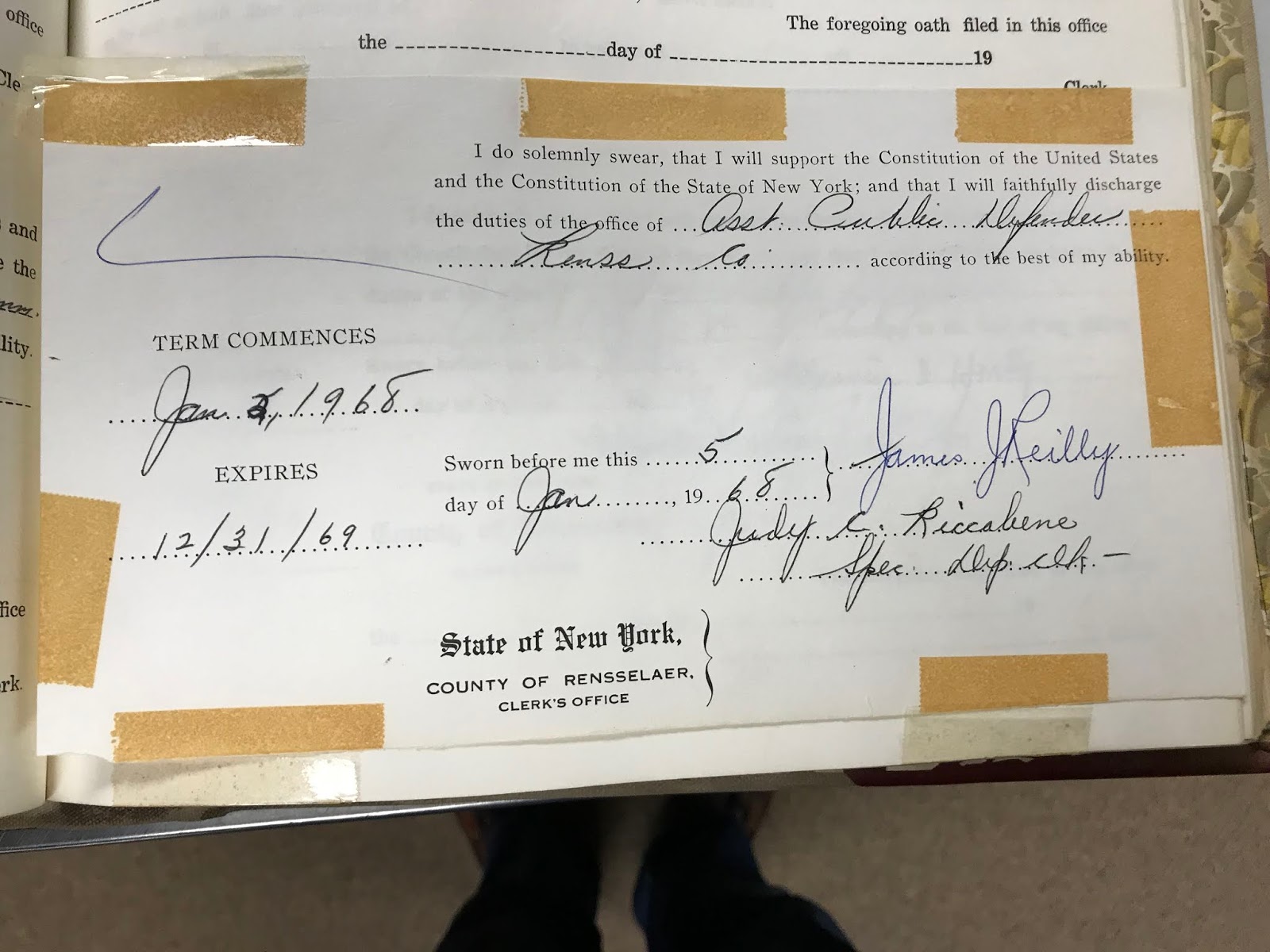
On the morning of January 5, 1968, Tom presented me with a letter appointing me to the office of an assistant public defender.  I brought it to the County Clerk, who swore me in and I signed the Oath of Office book.  The Troy Record photographer took a photograph of me being sworn in by the County Clerk, with Tom looking on.  I went to the Public Defender office and filled out the usual employment forms for tax withholding, health insurance, and the retirement system.  Later that afternoon, I received a telephone call from Lenore Coleman, Tom's confidential secretary. Lenore said there was a problem, and my appointment had to be postponed for a few days until the Board of Supervisors amended the budget to appropriate funds for my position.  I was very disappointed, but Tom told me it was an oversight and the Board of Supervisors would make the appropriation at its next meeting.  The oath of office that I executed that morning was covered with another oath of office, which was carefully scotch-taped over mine.  (During January 2020, I went to the bowels of the Rensselaer County Clerk's Office and found the 1968 Oath of Office book.  Ironically, my oath had been covered over with the oath of James Reilly, who later became my law office associate.  The scotch tape had dried out, and when I opened the book, the two oaths were uncovered. )


The Board of Supervisors met a few days later but didn't make the appropriation.  Tom was very upset and said he was told I should take John Burke's place.  We both agreed that it wouldn't be proper for me to replace John, and that had not been part of the arrangement.  Tom reported that back to the Republican hierarchy and said he was told the appropriation would be made in February.  Before the February meeting, however, Seymour Fox, the attorney with whom I was associated, told me that his friend, Dr. Carl DeLucia, told him I would not get the job.  Dr. DeLucia was a close friend of Dean Taylor, a former Republican County Chairman and Representative in Congress.  The reason, I was told, was that I had incurred the wrath of Dr. Richard Drumm, the Schodack Supervisor.  We moved to Schodack in 1964.  At first, Nedda and I became active in the local Republican organization.  I even incorporated the Schodack Republican Club, Inc. in 1966, and Nedda and I were charter members.  The problem began when I was retained to represent an elderly man who lived in a mobile home on a lot he owned.  The town board passed an ordinance that required mobile homeowners to get a special permit and pay a fee in addition to real property taxes.  The town building inspector charged my client with violating the ordinance for not having a permit, a minor criminal offense.  I demanded a jury trial, and the jury convicted him, following the justice of the peace's directions.  The town board was upset because a jury trial was expensive, and I said that I would represent anyone else that they prosecuted for a similar offense without charging a fee and would demand a jury trial in each case.  The town stopped enforcing the ordinance by criminal prosecution, although most mobile homeowners complied and paid the fee anyway.  The Schodack Republicans were also very upset with me for representing two party members who challenged the party regulars in the 1967 primary election, even though my clients failed to win.  The practice was that the County Republican Chairman would ask for the approval of a proposed appointee by the appointee's local Republican Chairman.  The approval was not forthcoming because I defended mobile homeowners and represented the primary challengers.

I was angered and frustrated, as I had considered the appointment a sure thing since Harry agreed to run, and there were to have been no other strings attached.  I knew that I had no legal recourse.  However, I probably could have salvaged the position had I gone hat in hand to Dr. Drumm and said that I would no longer defend trailer owners charged with violating the town ordinance, and generally fall into line with the town Republicans.


The official court reporter published all New York appellate court decisions and lower court decisions of interest.  To subscribers of the hardcover books, the official reporter would mail the "Advance Sheets", the softcover advance copies of the decisions.  These came out two or three times a month, and it had been my habit to bring them home to read to keep current on New York law.  I would usually skim all the cases, even in areas of the law in which I had little interest.  I recalled reading a decision from one of the Long Island counties in which the subject matter involved the equal representation of voters in local legislative bodies, Greenberg v. Board of Supervisors.  That New York case was based upon a United States Supreme Court decision, Reynolds v Sims, which mandated "one man, one vote" for legislative representation.  From my brief reading of that decision, I knew that the Rensselaer County Board of Supervisors, like most county legislative bodies in New York, did not measure up to the one man, one vote standard, as it was created under Section 150 of the County Law which prescribed that the Board of Supervisors consiste of the Town Supervisor of each town in the county, plus the Supervisors elected in each ward of the cities.


I realized that I could have my revenge!  There were no form books to guide me in preparing documents for the litigation, so I started going to the New York State Law Library, which maintained a copy of every appellate court record on appeal.  A record on appeal consists of all of the legal documents and lower court decisions in each case.  I photocopied the record on appeal of the Greenberg case and made my own manual.  I needed a plaintiff, someone with the legal standing to bring the lawsuit against the Board of Supervisors.  The ideal plaintiff was my wife, Nedda.  The town of Schodack had a large population compared to the very rural towns in the county, such as Stephentown, Grafton, and Petersburg, but each of the towns had one elected representative on the Board of Supervisors.  I told no one of my planned litigation, hoping that the politicians would yet honor the commitment that I had been given.  There was a little movement, although Tom O'Connor continued in his efforts to get the additional appropriation to hire me.


For a couple of weeks, I spent every evening typing pleadings.  Finally, just before the March meeting of the Board of Supervisors, I completed the summons, notice of petition, complaint, and petition entitled:


STATE OF NEW YORK

SUPREME COURT COUNTY OF RENSSELAER
----------------------------------------------------------------------------------
NEDDA R. HONIG, on behalf of herself and all other persons
similarly situated,

                                                          Plaintiff - Petitioner


                              -against-


THE BOARD OF SUPERVISORS OF RENSSELAER COUNTY

and THE STATE OF NEW YORK,

                                                Defendants - Respondents.

------------------------------------------------------------------------------------

Nedda signed the complaint/petition, and I notarized her signature and made multiple copies of the pleadings.  In those days, filing any papers with the court or the Clerk was unnecessary before starting an action.  The litigation sought a declaration by the New York Supreme Court that the Board of Supervisors was improperly apportioned; that under County Law Section 150, insofar as it mandated the structure of the Board of Supervisors, was unconstitutional, and directing a reapportionment of the Board of Supervisors consistent with the "one man, one vote" precedents.


On my 30th birthday, March 12, 1968, I went to see Jack Manning, the full-time Clerk to the Board of Supervisors.  I asked him if there was a resolution on the agenda for that evening's monthly meeting to appropriate funds to enable the Public Defender to hire an additional part-time assistant.  Jack was a former Troy police officer who had been appointed Clerk after his retirement from the police force.  He was decent and seemed genuinely embarrassed to tell me that the resolution was not on.  I handed Jack the pleadings and told him it was my present to the Board.


The next morning, the clock radio woke us up, as usual, to the 6 a.m. news on WGY.  The news broadcast started with Dick Beech announcing that "a Schodack housewife has sued the Rensselaer County Board of Supervisors complaining that she is not properly represented..."


The result was interesting to observe.  At first, the politicians considered the lawsuit to be just an irritant, as local governments frequently are sued by residents whose claims are dismissed as meritless.  However, it did not take long before all realized that my lawsuit created a new dynamic in Rensselaer County politics.  The Republicans, who for many years maintained control of the Board of Supervisors, realized their vulnerability; the Democrats, who had gained some vitality by electing some candidates to county offices in the Goldwater year, sensed an opportunity.


The initial court appearance was before T. Paul Kane, a Supreme Court justice from Schoharie County, who had been assigned to preside in Rensselaer County for the month.  Judge Kane, a former district attorney, was a Republican.  He was a tall man with silver hair and an even demeanor.  The Board of Supervisors was represented by the County Attorney, James T. Ronan.  Jim held the office part-time like all Rensselaer County Attorneys until 1984.  He was a member of Wager, Taylor, Howd, and Brearton, a prominent Troy law firm, one of whose members, Dean Taylor, was the local representative to Congress and a former Republican County Chairman.  Although the State of New York was officially represented by its Attorney General, Louis Lefkowitz, a Republican, the Assistant Attorney General assigned to the matter was Robert W. Imrie, an older attorney who represented that office in all prior reapportionment cases and who was generally considered to be the most knowledgeable reapportionment attorney in the state.  Mr. Imrie's legal position was consistent with mine, which he made clear to Judge Kane during the oral argument.  The Democrats intervened in the lawsuit.  The minority Democratic leader, Joseph Manupella, was represented by Thomas Kenny.  While their position favored reapportionment because they could not get control under the existing law, they always proposed reapportionment plans that would be most helpful to their candidates.


Once it was clear to the Republicans that there would be reapportionment, they sought to comply by offering a plan of weighted voting.  Under their plan, the Board of Supervisors would continue, but each Supervisor would have the number of votes corresponding to the number of voters in their district.  They hired an expert from Columbia University to prepare an analysis of the weighted voting plan for the Court, but Judge Kane rejected the plan and directed the Board of Supervisors to devise a plan for the creation of a County Legislature to be elected in the 1969 election.


Several plans were drawn up and submitted to the Court, which finally selected a 15 single-member district plan I had submitted.  Judge Kane's plan selection was upheld by the Appellate Division as an interim plan only.  The Republicans were furious since the town Supervisors wanted to continue as members of the County legislative body and the heads of their town governments.  They had the County Attorney prepare a local law permitting the Supervisors to also be members of the County Legislature, the so-called "two hats" law.  I told Jim Ronan that if they passed the law, I would immediately bring another lawsuit to declare it illegal as violating the Public Officer's Law.  I believe that Jim got an oral opinion from Robert Imrie that if any Supervisor were also elected to the County Legislature, he might forfeit the first office when he took the oath of office for the second one, and Jim convinced the Board of Supervisors to give up on that plan.


The Democrats were elated.  County Court Judge Timothy Fogarty called me to his chambers and asked if I would run for the County Legislature from the new district that included Schodack as the candidate of the Democratic party.  I told him that I would not, as I was a Republican, albeit a disenchanted one.  A few days later, he brought me back to convey that the Democratic County Chairman, Edward McDonough, said that if I wanted to run as an independent candidate, the party would fund my campaign.  Again, I declined.


The Democrats won control of the first County Legislature.  Before the election, Joseph Casey, the Republican County Chairman, was indicted following a lengthy investigation into corruption by the State Commission of Investigation.  The Republican party was in disarray and turned to Raymond Siek in 1970 to take over the county committee and cleanse its image.  Ray was the manager of Ford Motor Company's Green Island factory.  He had no political background, but he had an unblemished personal reputation.  Ray accepted the job, understanding that he would be the absolute boss.  He enlisted his top aide at the Ford plant, Nicholas Pinchuk, to work with him, and for several months, Nick spent much more time working for the Rensselaer County Republican Committee than he did for Ford.


A few weeks after Ray took over the party, his secretary telephoned me and asked if I would meet him and Nick for lunch at the Troy Holiday Inn.  (The Holiday Inn was also the location of the Republican Party Headquarters).  I agreed, and he told me his plan to clean up the party.  He asked me to help by writing new by-laws for the organization, and when I agreed, he appointed me vice chairman for legal affairs.  As a token of appreciation, he provided me what was then a party chairman's "perk", namely my MIH vanity license plate, which I kept until I moved to Florida in 2003.  (It was not until several years later that vanity plates became available for purchase by the public in New York).


With control of the new County Legislature, the Democrats drafted a new legislative reapportionment plan based on the 1970 census and required by the Court.  At Ray's request, I drew up a couple of different plans that favored the Republicans.  The matter came on before Judge Kane again, and he disallowed the plan submitted by the Democratic County Legislature and ordered one of my plans to be used for the 1971 election.  The Democratic County Attorney, Bill Jubic, appealed to the Appellate Division of the Supreme Court, which affirmed Judge Kane's decision.  Mr. Jubic then appealed to the Court of Appeals, the highest court in New York.  This was my first oral argument in the Court of Appeals.  The evening before the oral argument, Nedda and I took down 2 roll-up window shades from our home and pasted "exploded" views of the different plans on the shades, which rolled up like scrolls.  I unveiled them before the Court, whose members seemed both amused but impressed.  The Court of Appeals affirmed the lower court's decision.  The Republicans, reinvigorated by Ray Siek and the new legislative districts, took back the County Legislature in the November 1971 election by a slim 1-member plurality, and I was appointed County Attorney, a part-time office I held until the mid-1980s when I resigned because of the press of my private practice.  


Although the election was over and the Republicans took over the County Legislature, the Court still retained jurisdiction because the law required that the plan be adopted by a formal local law.  The Democrats, out of office but still being an intervening party in my reapportionment lawsuit, brought it back before the Court to have a new districting plan ordered for the 1973 election.  We all then realized that I was still the attorney for the plaintiff (Nedda), and as County Attorney, I had become the attorney for the defendant County Legislature, the successor to the Board of Supervisors.  The conundrum was resolved when I advised the Court, "I discussed the situation while in bed with the plaintiff last night, and she gave me permission to withdraw." Papers were signed, and I ceased representing Nedda, who continued in the lawsuit "pro se," technically representing herself. 

Prior to the 1971 election, the County Legislature adopted a local law providing for a county executive to be appointed by the County Legislature, similar to the form of government in effect in the City of Troy, which was dominated by the Democrats.  The local law was subject to a mandatory referendum, which was defeated, probably because of the history of failed appointed city managers in Troy.  I drafted a new county charter proposal with a bi-partisan commission that differed from the failed law.   The new plan provided that the chief executive officer would be elected at large in the County, and this plan was approved by the voters.  The Democrats nominated a prominent Troy politician for the office, but the Republican candidate, William J. Murphy, won handily.  (It did not hurt his candidacy that he lived in a Republican town and was half Irish and half Italian, the two largest ethnic groups in Troy)  The Republicans have never since lost control of the office of County Executive.  

Note:  Now that so many years have passed, there is no harm in my telling that Mr. Murphy was not Ray Siek's first choice to be the first County Executive candidate.  At Ray's request, I approached the late Edward "Ned" Pattison, a lawyer from a prominent family, and asked if he would run for the office as a Republican.  Ned, a Democrat, had been elected to Congress during the Goldwater Year and was elected County Treasurer after losing his bid for re-election to Congress.  Ned declined and asked me to thank Ray for the offer.   

Note:  When the control of the county legislative body changes, the successful party generally installs its own party members in non-civil service positions.  When the Republicans regained control of the County Legislature, and I was appointed County Attorney, among the Democrats they intended to replace was Whitey Courier, who was in charge of the Tax Mapping Department.  Soon after I was admitted to the bar in 1963, Whitey, then the mayor of the Village of Nassau, appointed me as the Village Attorney.  To return the favor, and perhaps because I was partly responsible for his election defeat by my uncle, I insisted that he not be replaced by a Republican.  He continued in that position until his retirement.

Friday, October 01, 2021

Assistant District Attorney

I had a short career as an assistant district attorney in Rensselaer County. In August 1971, Con G. Cholakis, the district attorney who had been my adversary in a series of criminal cases and appeals, invited me to join his part-time staff of assistant district attorneys. I readily accepted as I liked “Gus,” and I was growing weary of representing low-lives, who usually didn’t show any appreciation if I obtained a favorable result for them and who usually were guilty. Also, I wanted to experience what it was like to be on the “other side of the fence.” It was an easy and enjoyable transition from a criminal defense attorney to a prosecutor. There were great resources available to the prosecutors. The police agency that arrested a criminal defendant was obligated to do any follow-up investigation, and the office also enjoyed the services of Jack Dwyer and Joe Burns, two experienced police officers who were employed full-time as investigators. Additionally, the prosecutor could choose to not prosecute a weak case, or to plea bargain down a questionable case.

The assistants would rotate handling cases. We were all part-time employees with private law practices. Troy Police Court, which provided the bulk of cases handled by the office, took up the mornings for one or two weeks each month, depending upon the rotation. The same assistant would usually handle subsequent felony hearings for defendants arrested during his rotation and present the case to a grand jury. We would also handle town court cases one or two evenings a week.

I was very familiar with the workings of the district attorney’s office. I took a summer job in that office between my second and third years of law school. The summer jobs in county agencies were usually given to the high school or undergraduate college students who were children of political committeemen of the party that controlled the agency. I was able to get the job because my uncle, Harry Honig, was the Nassau Town Supervisor. I had just completed a criminal law elective taught by John T. Casey, then the District Attorney and an adjunct professor at Albany Law School. I was not expected to do much more than observe, as summer help wasn’t expected to do much work. However, I usually went to Troy Police Court each morning with one of the three assistants, Jim Reilly, Pierce “Bud” Russell, or John Burke, and they utilized me to do research and draft court documents, thus freeing more of their time for their private practice. I was given access to all of the open and closed files. I sometimes found closed cases involving people I knew, including a criminal prosecution involving the sexual activity of a couple of high school classmates. There were no trials to watch because the Supreme Court and the County Court did not hold trial terms during the summer months. I was a good typist (out of necessity because I have terrible handwriting), and Kay James, Mr. Casey’s confidential secretary, frequently asked me to write letters reducing motor vehicle charges in town courts “in the interest of justice.”

A couple of months after I became an assistant district attorney, a bookstore opened on Broadway in Troy. Soon, complaints rolled into the police that the store was selling pornography. This was in the days of Ozzie and Harriet reruns, and the citizenry was outraged that such materials should be sold at all, particularly across from the Post Office and within a couple of blocks of two churches. Gus asked me to look into the situation, so one morning I enlisted Jack and Joe and we went to the book store and looked at the merchandise. Although some of the magazines were of the Playboy genre, there were a lot of magazines and 8 mm movies with suggestive covers that probably would have shocked Ozzie and caused Harriet to faint. I decided that there was sufficient evidence for a prosecution. Jack and Joe locked the door and announced that they were police officers and were arresting the sales clerk for the sale of pornography. At the time, there were a couple of patrons in the store who panicked at finding themselves locked into the store where an arrest for pornography was taking place. Jack and Joe took their names and let them out of the store. We filled several boxes with the most pornographic magazines that we could find, as well as the movies that had the most suggestive titles, and brought them back to the office. The clerk, a young man who was merely an employee, was charged in Troy Police Court with the sale of pornography.

We learned that the store was actually leased by a Massachusetts corporation, and I received a telephone call from its attorney, who told me that the corporation had several such stores in New England, and the Troy store was its first in New York. He told me that “accommodations” could be made if the prosecution was dropped, a suggestion I didn’t care for as it hinted at a bribe. I told him he had a serious problem because the Massachusetts corporation hadn’t filed the necessary papers with the New York Secretary of State to conduct business in New York, which he said must have been overlooked, which he promised to correct.

When the clerk’s case came on for a hearing in Troy Police Court, he was represented by a prominent local attorney hired by the corporation. The attorney gave an impassioned statement that it was wrong to criminally prosecute this young man, who was merely trying to earn a living selling what he had been told was perfectly legal merchandise. I told the court I agreed and went on the record dismissing the charge and granting him immunity from prosecution. The attorney’s pride at having convinced me to drop the charges against his client faded away when Jack immediately handed the clerk a subpoena to appear before the grand jury the next day. Having immunity, the clerk had to testify, and the grand jury handed up a sealed indictment charging the Massachusetts corporation with the pornography crime. By then, the corporation had filed its certificate to do business in New York, a condition of which required the corporation to agree to the jurisdiction of New York courts for acts committed in the state and appoint the Secretary of State as the corporation’s agent to receive and forward legal process. The indictment was thus served on the corporation.

The Massachusetts corporation did not roll over. It immediately commenced a lawsuit against Gus, me, and the County of Rensselaer in the United States District Court for the Northern District of New York to enjoin the criminal prosecution as a violation of free speech and for damages. The first appearance came in the federal court in Albany before Judge Foley, a resident of Troy. The corporation’s attorney made a very eloquent presentation, but Judge Foley protested that he didn’t know what was or was not pornography and refused to look at the several examples I tried to hand up for his inspection.

A compromise was reached after some conferences with the corporation’s local attorney. The corporation withdrew its lawsuit and closed the bookstore with an understanding that it would not return to Rensselaer County. The corporation pleaded guilty to a reduced charge and paid a fine.

One morning, I returned to the District Attorney’s office just before noon to drop off the morning's Troy Police Court files. It had been a busy session. I was eager to return to my private office to check my calls and go for lunch with Jim. When I walked in, Tess, Gus’s confidential secretary, told me that Gus wanted me to cover for him at a convocation of mental health professionals at the Veteran’s Administration Hospital in Albany. Gus was scheduled to be a speaker at the one o’clock session to give a prosecutor’s viewpoint on suicide prevention and other legal mental health issues. Unfortunately, Gus was tied up in a trial in County Court and couldn’t break free to fulfill the commitment.

As I drove to Albany, I thought about what I could say about the legal aspects of suicide prevention to a group of psychiatrists and psychologists. Mentally, I pieced together a brief talk that centered around one method once used in the United Kingdom to discourage suicide: all property owned by the person committing suicide would be seized by the Crown, the thought being that no one would want to financially punish his family by impoverishing them by his suicide.

I arrived at the VA Hospital and was ushered into the auditorium and onto the stage just as the group returned from lunch for the afternoon session. Gus was one of three scheduled speakers, the others being a minister and a New York State Police senior officer. The minister was up first, but he announced he wanted to give his time to two other men he had brought along. He introduced two young men who held hands and spoke about how they and other gay men frequently thought about suicide because they were continually harassed, particularly when being together in Washington Park. I sat there thinking, “I am missing lunch for this crap?”

The officer was up next, and to my dismay, he gave practically the same talk that I had been planning. (I later learned that he had attended but not graduated from Albany Law School and learned the same history of suicide from Dean Clements, who taught criminal law to first-year students.) 

Suddenly, it was my turn, and I had no idea what to talk about when I was introduced. I decided to talk about a young man whose prosecution I had been handling in Troy Police Court. He was on suicide watch at the Rensselaer County Jail. He was originally arrested for setting fire to some street trash. A psychiatric examination was requested by his assigned counsel, Thomas O’Connor, Sr., and Judge Fogarty reported that Dr. Morgenstern, the director of the county’s Mental Health Board, had found him to be “sound as a dollar.” He was released on bail but was soon rearrested while walking nude up the center of Hutton Street, telling the arresting police that God had instructed him to show people what a real man looked like. After this arrest, a formal two-physician examination was ordered. The result was as follows:


I then spoke about how the legal profession viewed (at least in my view) psychiatrists. I said that lawyers had little regard for psychiatrists as witnesses as they would usually find whatever results were needed by the employing attorneys. As an example, I mentioned the case of a fourteen-year-old boy charged with juvenile delinquency who I represented as his law guardian in Family Court a couple of years ago. The boy admitted to shooting his father in the head with the father’s handgun, and the issue was what the disposition should be. The County Attorney (who prosecutes juveniles in Family Court) produced a psychiatrist who testified that the boy was dangerous and should be confined. I produced a psychiatrist who testified that the only person ever in danger by the boy was his father, and since his father was dead, there was no medical reason to confine him. [The boy was placed in the custody of his paternal grandmother.] I mentioned that our County’s Mental Health Director was routinely referred to as “Dr. Foreskin” by Judge Fogarty and many defense counsel and prosecutors who routinely practiced in Troy Police Court. That statement brought murmurs from the audience.

Later that afternoon, Tess telephoned and asked me to come to the District Attorney’s office. When I got there, she told me that Gus was getting repeated calls from Dr. Morgenstern, who had received reports about what I had said from some of his staff members who had attended the convocation. Gus was still in court, and Tess was worried about what to tell him. When Gus came in and I told him what happened, he laughed and said he would “calm Foreskin down.”

A short time later, I was drafted by the incoming Republican-dominated County Legislature to be County Attorney. As such, I became the attorney for all county officers, including Gus and Dr. Morgenstern. Gus went on to become Rensselaer County Judge, New York Supreme Court Justice, and United States District Court Judge. Dr. Morgenstern retired to Palm Springs in the 1980s.

Wednesday, September 01, 2021

(Very) Early Morning Court in Troy

One cold February night in 1975, John D., Esq., an Albany Law School alumni, got word that his two brothers had been arrested by officers of the Troy Police Department for driving while intoxicated, public intoxication, public lewdness, and a violation of Troy’s open container law. Like any good attorney and brother would do, he arranged for his brothers to be arraigned in the basement of the home of Supreme Court Justice William R. Murray at 4:00 A.M. One brother pleaded guilty to a charge of reckless driving, and the other brother pleaded guilty to public intoxication. Justice Murray imposed a fine in both cases but immediately suspended the sentences. 

Justice Murray filed the record of the proceeding as an order of the Supreme Court in April, and the District Attorney appealed the order to the Appellate Division. That appeal brought the issue of the jurisdiction of the Supreme Court into sharp focus: Could a Supreme Court Justice preside over misdemeanor cases as if he were a local criminal court judge?
In its precedent-setting ruling, subsequently cited by the Court of Appeals, the Appellate Division answered in the affirmative but stated: “Finally, while we have upheld jurisdiction in this case, we do not condone the manner in which this case was handled."

Sunday, August 01, 2021

Infant Settlements

A competent adult can settle a lawsuit with a signature, but the rules differ for a child. Under the New York civil procedure, court approval is necessary to settle the claim of an infant, a person under the age of eighteen years. Most negligence claims arise from automobile accidents, fall downs, or dog bites, and a substantial number of those claims are the claims of injured children.

When an adult's claim is settled, the claimant's attorney draws a general release, which specifies the party being released, the amount being paid for the settlement and release, and a brief account of the nature of the claim. However, if the infant is the claimant, the claim's fairness must be reviewed by a judge. A judge of the court in which a lawsuit is pending reviews the application. If the settlement was arrived at before the commencement of a lawsuit, the application could be made to any judge having territorial and monetary jurisdiction over a lawsuit brought on the child's behalf. 

An application for an "infant settlement" is prepared by the child's attorney. It includes a petition by the child's parent or legal guardian setting for the nature of the child's injury and claim, expenses incurred, and reasons why the petitioner thought that the child's best interests would be promoted by a settlement. An affidavit by the petitioner's attorney addresses the legal issues (usually suggesting that the child might either lose at trial or not recover more than offered in settlement). Also attached are pertinent medical records, police accident reports, and an affidavit from the child's attending physician setting for a brief statement of the treatment and prognosis. These papers are then topped by a proposed order to be signed by the judge approving the settlement and terminating the child's future rights to sue. An appointment would be made with the judge. At the appointed time, the child, his parents or legal guardians, and their attorney would appear before the judge in his chambers to discuss the settlement, and once satisfied, the judge would sign the order. The order would provide the amount of attorney's fees, and if the settlement was substantial, it would direct that the net recovery be put in a special bank account to be withdrawn when the child reached his majority. Earlier partial withdrawals were permitted for good cause. 

Different judges took vastly different approaches to their review of infant settlements. Troy City Court Judge Matthew M. Dunne was at one end of the spectrum. Judge Dunne was a part-time civil court judge who maintained a private law practice on Second Street, specializing in wills and estates. He was a true gentleman. Attorneys loved to bring infant settlements before him. Although he usually knew nothing of the proposed settlement before meeting with the attorney and his clients, he would skim the pages and announce that the proposed settlement was among the finest he had ever seen. He praised the lawyer and wondered out loud how the lawyer was able to get such a large settlement, or a settlement at all, given the facts of the claim. The child's parents would beam when  Judge Dunne suggested that they must be very clever to have hired such a fine lawyer. With a flourish, he would sign the settlement order.

The other extreme was DeForest C. Pitt. Judge Pitt was from the small Village of Hoosick Falls. He was politically connected and had been County Attorney and then County Court Judge. The rumored mistress of a Republican political leader was his appointed confidential secretary. He was eventually elected to the Supreme Court, a trial court that handled mostly civil cases. Since Judge Pitt was the resident Supreme Court judge, infant settlements in cases that were pending in that court frequently came before him, as did other proposed settlements in which the monetary amount exceeded the Troy City Court's jurisdiction. To the extent that Judge Dunne made an attorney look brilliant, Judge Pitt made attorneys appear wholly incompetent. He read every word of the documents in the presence of the infant and parents. Like a proofreader, he corrected grammar, added or deleted sentences, and marked up the documents with relish. Once, I saw him change an affidavit that had been signed by a physician! He questioned the infant and parents and frequently broadly hinted that although he was approving the settlement, he thought the amount was low. Sometimes, he would get on the telephone and call the insurance adjuster who had made the settlement offer and try to increase the offer. That ploy sometimes resulted in a modest increase in the settlement since it was difficult for most insurance company adjusters to refuse a Supreme Court judge who started the discussion stating that he was about to reject the settlement unless the amount was increased. The obvious result was that the infant's parents left the proceeding believing that their attorney was incompetent and thankful that Judge Pitt had become their advocate and was so willing to correct all of their attorney's mistakes, which were obvious to him.

While annoying, it was not too much of a problem to wind up with an infant settlement order that had been marked up because the client did not typically get a copy of the order to take home. The original order was filed in the County Clerk's office. A conformed or photocopy of the order was sent to the insurance company or the other party's attorney who was paying the settlement. They were used to receiving Judge Pitt's marked-up orders. 

 However, it was another matter when Judge Pitt signed a divorce or annulment judgment. A judgment in a matrimonial action was the end product that a client took with him or her, and attorneys wanted that to look perfect (even if the terms were not always what the client had hoped for). A matrimonial judgment was not signed in the presence of the client. After the matrimonial hearing, the prevailing attorney would purchase a transcript of the testimony and the judge's oral decision and prepare a written Finding of Facts and Conclusions of Law and a separate Judgment for the judge's signature, which was delivered to his chambers to be reviewed by the judge's law clerk and then submitted to the judge for his review and signature. Judge Pitt would mark up the proposed judgments as he did with infant settlement orders. Like many other attorneys, I did not want my clients to receive a messy document, so I would have my secretary retype the order, incorporating all of Judge Pitt's modifications, and resubmit it to his chambers with the originally signed judgment. This was before the common use of even rudimentary word processing equipment, so the judgment would have to be retyped from scratch, but the result, a clean document, was worth the extra effort. I always studied the changes that Judge Pitt made to my matrimonial judgments and incorporated such changes in future documents that I submitted to him. One day, his law clerk, Paul V. Morgan, Esq., brought out a divorce judgment signed by Judge Pitt that did not have a single mark on it. Paul was beaming and told me that it was a first. I was confident that I now had the exact language that Judge Pitt wanted. A few days later, I submitted the judgment in a similar divorce case that mirrored the prior, unblemished judgment in every possible way. It came back to me marked up with a whole new set of changes added by Judge Pitt in his bright, blue ink.

Thursday, July 01, 2021

Litigation


It is not infrequent that an attorney's clients consult regarding some wrong they have suffered due to a commercial transaction that did not meet their expectations.  After listening to the client's story of the history of the transaction and reviewing the documents the client provides, an attorney will usually try to resolve the matter by a telephone discussion with the other party or a letter to that party requesting a resolution of the issue.  If a satisfactory resolution is achieved in this manner, the cost to the client is minimal, and frequently, the attorney will not even bill the client for the modest effort involved.

Sometimes, however, the telephone call or letter approach fails, leaving litigation as the only recourse open to the client.  Litigation is always time-consuming and expensive.  If the monetary amount of the loss the client has sustained is not significant, I would frequently suggest that clients represent themselves by bringing a lawsuit in a local small claims court, which usually has jurisdiction for claims that do not exceed $5,000 or so.  In those small claims courts, the claims are simply stated in the claimant's own words on pre-printed forms, and the filing fee is nominal.  Neither party is usually represented by counsel, and the judge listens to both sides and renders a quick decision, not too much, unlike the "Judge Judy" television show.

Small claims courts only work out for some clients in many situations for various reasons.  Some people feel uncomfortable going before a judge by themselves or feel that the issue is too complicated to explain.  In any discussion with a client regarding the practicality of employing the attorney to commence a lawsuit to press their claim, the attorney is usually quick to advise the client that even if the client prevails and gets the monetary judgment, the client is entitled, they may still suffer a loss because in most cases the court cannot award attorney's fees as part of the judgment.  Some contracts stipulate that the prevailing party can recover reasonable attorney's fees, but that is a double-edged sword because if the client does not win, he may also have to pay the other party's attorney's fees.

In my practice, I always tried to discourage clients from employing me to represent them to sue on modest claims, even though they sometimes said that the cost be damned; they wanted to sue on principle.  In the latter years of my practice, I used this personal example of how involved and expensive pursuing a modest claim in court can be.

Soon after building a new home in the early 1990s, my wife and I employed an interior decorator, Richard Seiden, to help us furnish the home.  Richard did an excellent job and took us to a design center in Manhattan, where we purchased much of our new furniture, including a large, curved sectional sofa for our living room, which was elliptical in shape.  Our home had oak floors, but Richard suggested using area rugs in some places.  The first area rug needed was an 8 x 8 square for our breakfast area.  Richard sent us to David Cohen's Lektro-Kleen, Inc., a commercial rug cleaner and fabricator who had been in business for many years in Albany.  Richard helped us choose the rug materials, and Mr. Cohen's company fabricated the rug promptly and for a reasonable price.  We were very satisfied.

After our living room furniture arrived, Richard offered to design an area rug that would visually tie the furniture together.  The rug was designed to follow the elliptical shape of the room and the contour of the curved sectional sofa.  The rug was to be fabricated in purple with a black border.  We showed the design to Mr. Cohen, and after he came to our home to view the job, he told us that he could make the rug Richard had designed and made notes and sketches.  We purchased the materials through Richard for $1,996.42 and employed Mr. Cohen's company to fabricate them for an agreed price of $1,400.00.
In May 1994, two workmen came to the house to make a template for the rug.  They did not have Mr. Cohen's notes or sketches.  They used a rope to outline the rug area, then moved the furniture and made a large paper template.  The workmen did not place the furniture on the template to check it.  A few weeks later, the workmen brought the finished rug, but after the furniture was placed on it, it became clear to us that the curve did not match the curve of the sofa, and the workmen brought the rug back to their shop.  After that, it became difficult to communicate with Mr. Cohen, and Richard became the intermediary.  A meeting was arranged at our home, and although the workmen brought the rug back for the meeting, Mr. Cohen didn't show up, although he had told Richard that we would personally come to inspect the problem.  Richard showed the workmen the problem, and after they agreed that they could not move the furniture to match the curve of the rug, they made a new template with the furniture in place.  The employees agreed with Richard that the template should have been made in this manner initially.

Everything went downhill from that point.  Mr. Cohen wouldn't return my telephone calls and told Richard he wanted us to buy more materials to piece on the rug, which was unsatisfactory.  In addition, he wanted to be paid before doing anything further.  By November 1994, he had stopped taking Richard's calls and didn't respond to my letters, so I decided that litigation was the only resolution.

Even though our claim was well within the monetary limits of small claims courts, I preferred to sue Mr. Cohen's company in the Supreme Court.  Had I elected to sue in the small claims section of Albany City Court, which had jurisdiction because the business was located in Albany, I knew that I could lose a morning waiting to be heard because of the crowded calendar, and the law permitted me to sue instead in Rensselaer County, where we lived, and which was convenient for me.  I thought that when he received the summons and complaint, Mr. Cohen would come to his senses and try to resolve the matter instead of incurring the cost of employing a lawyer to defend the case.  I didn't know that his daughter, Elise Hiller, had recently been admitted to the New York bar and was employed at Albany Law School.

Ms. Hiller answered the complaint, denying that the rug's construction was faulty and counterclaiming for the labor of fabricating the rug and for storage fees for storing the rug at the shop.  There were no negotiations, and the litigation proceeded.  I placed the case on the court calendar for trial, but because the amounts in contention were less than $10,000, the rules required that we submit to mediation.  We spent the better part of a day before the mediator, a young female attorney assigned by the court to hear our case.  My wife and I testified, as did Richard on our behalf.  Mr. Cohen and his workmen testified on the defendant's behalf.  At the conclusion, the mediator directed that Mr. Cohen remake the rug but did not give any monetary award to either party.  I asked the mediator how I could enforce her decision if the remade rug was unsatisfactory, and she replied that she knew no way of enforcing it.  Once again, I put the case on the Supreme Court calendar for trial.  This time, a conference was held before Judge George Ceresia, which was not productive.  Judge Ceresia assigned the case to be heard by M. Andrew Dwyer, a retired Rensselaer County Judge.

Photo taken during Court Observation
The trial in Rensselaer County Supreme Court was a more formal replay of the mediation.  I testified by asking myself questions and answering them, and I acted as the plaintiff's attorney in questioning the other witnesses.  Ms. Hiller elicited the testimony of her father and his workmen.  At the conclusion of the testimony, Judge Dwyer said that he could not reach a decision without seeing the rug and furniture and adjourned the case to a future date at our home.  Judge Dwyer and a court clerk and stenographer came to our home.  Mr. Cohen and his workmen brought the rug back and put the furniture on it, adjusting it as best as possible to match the curves.  After inspecting the rug, Judge Dwyer announced that he required further testimony and set a date to reconvene in court.  At that time, Judge Dwyer asked a few innocuous questions and then announced that his decision was in our favor and against the defendant.  Based on a transcript of Judge Dwyer's decision, I entered a judgment against Mr. Cohen's company for $3,479.98, which included our original $1,996.42 for materials, interest, statutory costs, and out-of-pocket litigation expenses.  I then sent a restraining order to his bank to freeze that amount and an execution to the Albany County Sheriff to pick up the money.  I thought (hoped) that would be the end of the saga, but it was not to be.


Ms. Hiller promptly filed an appeal of the judgment to the five-judge Appellate Division of the Supreme Court and made a motion to stay the collection of the judgment pending the decision on the appeal.  The court granted the stay on the condition that her client deposit the total amount of the judgment with the court clerk.  Although court rules require that an appeal be perfected by filing a record on appeal, consisting of all court documents and a transcript of testimony, together with the appellant's brief (written legal argument showing why the trial court's decision was an error), be filed within 60 days, Ms. Hiller repeatedly requested extensions of time until she was given a final deadline by the appellate court.  She finally filed the required documents, including a brief citing numerous cases to support her contention of error. A date for oral argument was set by the court.   By this time, I was disgusted with the time that the litigation had taken.  I submitted a brief reply of a cover sheet and one page that basically said that the cases cited by Ms. Hiller were irrelevant.  I notified the clerk of the Appellate Division that I would not attend the oral argument.

A few days later, the appellate court issued a one-sentence decision denying the appeal.  Since the decision was unanimous, there could be no further appeal, and I collected the judgment money from the court clerk.


Litigation, Part II


 In 2002, Tomhannock, LLC, a limited liability company I owned with a partner, entered into a contract to sell a 15+ acre parcel near the Tomhannock Reservoir in Pittstown, New York, to DiLallo.  This had been approved by the planning board for a single-family residence, as it had an adjacent 15+ acre parcel.  Tomhannock had initially wanted to carve out a 3.5-acre parcel from the front of both parcels and had them surveyed but did not get local planning board approval.  The purchase price was to be $105,000, but DiLallo only wanted to put down $50,000, so we fashioned a deal by way of an option agreement, which provided that if DiLallo failed to pay the balance of $55,000 within 10 years, he would convey the 3.5-acre parcel back to Tomhannock.  A similar arrangement was made with the purchaser of the adjacent parcel, who soon paid off the balance, and we released the option for that parcel.


DiLallo decided not to build and sold his parcel to LaPorte.  During early 2011, before the expiration of the 10-year period, Tomhannock, having not received the balance of $55,000, demanded that LaPorte execute a "reconveyance deed" of the 3.5 acres back to Tomhannock as provided in the option agreement.  Instead, while I was negotiating the matter with LaPorte's attorney, LaPorte sold the parcel to Roundabout Resources, LLC, a New Mexico limited liability company with its official address in the Canary Islands, Spain, in July.  The deed to Roundabout Resources showed its address as being in Fairbanks, Alaska.  I wrote to that address and received a letter stating that Roundabout Resources was not obligated to execute a reconveyance deed because its subdivision had not received planning board approval.  I then did some research and learned that the Alaska address was merely a paid mail drop, obviously intended to mislead Tomhannock as to its true owner and location.  I found that Roundabout Resources, LLC,  was owned by Kyle Litz, a resident of nearby Saratoga County who is a chemist with a Ph.D.

As I was then living in Florida, I worked with my Troy attorney, Thomas Spain, and commenced an action in the New York Supreme Court to compel the execution and delivery of the reconveyance deed.  That was in 2012.  Mr. Litz retained a large law firm to defend the lawsuit.  There were no settlement discussions since Tomhannock's position was that Roustabout Resources had to honor the terms of the option agreement (binding upon all of the subsequent owners) or pay the $55,000.  Roustabout stood firm in its position that it was not required to do anything absent planning board approval, and without the approval, a deed to the reconveyance parcel could not be recorded.  

During the litigation, the case came before a trial court judge on three different occasions, each ruling in favor of Tomhannock. Roustabout Resources appealed two of the rulings to the five-judge Appellate Division, which affirmed the trial court's decisions.  Finally, Roustabout Resources twice appealed to the seven-judge Court of Appeals, the court of last resort in New York, which on June 4, 2019, unanimously affirmed all of the lower court decisions and required the delivery of the reconveyance deed, together with statutory costs to Tomhannock.  33 N.Y.3d 1080 (2019)  I circumvented the local requirement that subdivided parcels could not be recorded without planning board approval by attaching the deed to the Court of Appeals decision that was filed in the County Clerk's Office, and a title company then insured title, permitting its sale.

 Litigation of this type, with three proceedings before a trial-level Supreme Court judge, two appeals to the Appellate Division, and two appeals to the Court of Appeals, is both unusual and costly.  Roustabout Resources' expenses must have significantly exceeded the $55,000 it could have paid to retain the 3.5-acre parcel because it not only used an expensive law firm but it had to pay for printing the extensive records of all of the prior proceedings for each court appeal, the filing fees, and ultimately Tomhannock's statutory fees as the prevailing party.  Also, during the almost seven years of litigation, Roustabout Resources could not sell its parcel because the litigation rendered it effectively unsaleable.  During that period, the value of rural land in this area of Rensselaer County tanked as rising property taxes and development costs made selling it for anything other than a fraction of its original value unlikely.

I then owned the 3.5+ acre parcel and offered to donate it to a conservation not-for-profit organization in Rensselaer County, but the donation was refused because it was too small.  Instead, I sold it to an adjoining landowner.  From my perspective, the litigation was a matter of principle that I could afford to fund, and I never doubted that Tomhannock would prevail.  I remain amazed that Mr. Litz's attorneys or Mr. Litz apparently did not understand the controlling legal issue.

 When the litigation was over, Mr. Litz telephoned me, and we discussed the case.  He was surprised that I was able to get the reconveyance deed recorded without municipal approval, and he told me that although he purchased the property with the intention of building his forever home, his plan now is to retire to his native Texas.


Saturday, May 15, 2021

Jim Goes to Family Court

The Family Court in New York State is the court that handles various private matters, including juvenile delinquency, persons in need of supervision, and matters relating to child custody and support of dependents.  The court was formerly known as the Children's Court but became the Family Court in 1962.  Among the cases frequently heard are petitions brought by the county social services department seeking financial assistance for persons receiving public assistance.  These "welfare cases," as they were known, are usually brought against the father of an out-of-wedlock child or a divorced or separated husband who has failed to support his former spouse or children.  The Family Court has the authority to determine responsibility and direct the terms of support in an appropriate case.  The court can enforce its orders by a contempt order, including remanding a person who fails to comply with jail.

Family Court proceedings are supposed to be private.  Unlike other courts, the public cannot view its proceedings or access its case records.  Family Courts usually have relatively small courtrooms, frequently located in the county courthouses in upstate New York counties.  Cases are staggered to provide the necessary privacy.

Unlike Rensselaer County, which housed its Family Court in an appropriate facility and heard cases from all fourteen towns and two cities, the Albany County Family Court, in the early 1960s, used an open area in the old (since remodeled) Albany County courthouse for its hearings.  In further violation of privacy, then Family Court judge Robert J. Laffin, a former Albany Police Court judge, "rode the circuit" on Friday mornings once or twice a month, stopping first in the City of Watervliet, where he held proceedings in the open City Court courtroom and then traveled north to the City of Cohoes where he held hearings in the open City Court.

One Friday morning, probably in 1964 or 1965, I arrived at the office of Seymour Fox, where I was then employed and was instructed by Mr. Fox to go to the Cohoes City Court to represent a young man, who I will call "Jim".  Jim was a client of Mr. Fox, who was handling his injury claim.  At this time, anyone of the age of 18 could buy and consume alcohol, but a male who had not reached his majority, then age 21, could not be married by a Town Justice of the Peace (as Town Justices were then known) without parental consent.  Jim was 20 years of age.

When I arrived at the Cohoes City Court, perhaps two dozen people were in the room awaiting their turn before Judge Laffin.  Jim showed me a petition that had been served upon him, whereby the Albany County Department of Social Services was seeking an order for him to pay support for his wife and her two children, who were welfare recipients by a former marriage.  Jim told me that he had had a brief affair with this divorced woman a couple of months previously.  Following an evening of drinking, they went to a local Town Justice of the Peace who performed a marriage ceremony, although they didn't have a marriage license.  Based on these facts, I had two defenses: (a) the marriage was invalid because there was no marriage license, and (b) even if there had been a marriage license, there had been no consent by Jim's parents.  Jim never lived with his "wife" and hadn't even seen her again after they broke up shortly after the marriage ceremony.

Support cases are civil in nature.  Unlike a criminal charge to which an accused enters a guilty or not guilty plea, a civil petition is responded to by admitting or denying each allegation and, when appropriate, setting forth any defenses. 

When Jim's case was called, I went to the bench with Jim.  Judge Laffin read the petition and asked Jim, "How do you plead guilty or not guilty?" I was astounded!  Even though this was my first Family Court case, I knew it was not proceeding properly.  I interjected that on Jim's behalf, I wanted to admit certain allegations of the petition, deny others, and explain his defense.  Judge Laffin looked at me, then turned to Jim and asked: "Guilty or not guilty?" Once again, I tried to explain that I wanted to respond to the allegations but was ignored.  The next time he was asked, Jim said, "Not guilty." To my surprise, Judge Laffin said he was being remanded to the Albany County Jail.  Jim was put in handcuffs and led away by a bailiff.

I was at a total loss and couldn't believe what had happened.  I waited until Judge Laffin went through the entire calendar of cases and approached him.  With the audience gone, I tried to discuss the matter, but Judge Laffin told me to be at the Family Court in Albany at 2:00 pm that afternoon for a hearing.

Shortly after I arrived, Jim was led in, still handcuffed.  Judge Laffin then read the petition and a written response that I had hastily prepared.  He questioned Jim about his age and the circumstances of the marriage ceremony.  He then said the marriage was obviously invalid, and Jim was not required to pay any support.  He dismissed the petition, ordered the bailiff to remove the handcuffs, and told Jim he was free to go.

I never appeared before Judge Laffin again, but I understood that his successors followed proper procedures.  

Saturday, May 01, 2021

No Worm, No Conviction

My father was an avid fisherman. He flirted with fly fishing for a time, but to say that he never mastered the art would be an understatement - he never caught a single trout on a fly. With the advent of spinning tackle, he tried his hand at fishing with lures, going so far as to buy a kit to make his own lures. He would mold a plastic dough into what he thought the trout would be attracted to, adding bits of feathers and hair from a deer’s tail that he unceremoniously chopped off a hunter’s buck for that purpose one November day. [He had not consulted with the hunter who had stopped at my father’s tavern for a few drinks to celebrate his hunter’s prowess and show off the buck tied across his front fender in the usual tradition.] My father’s success with spinning lures equaled his success with fly fishing, probably because my father’s idea of what a trout would consider edible was at variance with the trout’s concept of food. He had had some luck using lures that he purchased in the sporting goods section of Montgomery Ward, but using bought lures proved too expensive for him, as the rocky bottom of the Kinderhook Creek ate more of the lures than the trout did. Although many trout fishermen succeeded with live bait, my father had no convenient source of shiners and never really considered that option.

Dad finally resigned himself to being a worm fisherman, and as such, he became a master. Earthworms were readily available and free for the digging. We maintained a good supply in a big wooden box in which soda was delivered in the 1950s and 1960s. The box was lined with screening to keep the worms from escaping, and they were fed cornmeal or stale bread. Sometimes, I would take a flashlight and hunt for nightcrawlers to add to the worm population. In any event, Dad had a ready source of bait at his disposal, and during April and May, he would go fishing several times a week in the nearby Kinderhook Creek or its tributaries. He knew every “hole” where trout would likely feed and rarely came home empty-handed. Some days, when the fishing was exceptional, he would bring home the legal limit of ten trout, eat breakfast, and return for some more. On the weekends, when many trout fishermen came into his tavern after fishing, he took particular delight in listening to their tales and then bringing out a trout platter he had caught earlier that morning. His catch usually was larger than that of his customers. He especially enjoyed showing his catch to the fly fishermen. One year, a large photograph of him fishing on the opening day of the trout season appeared on the front page of the Times-Union’s sports section, giving him some celebrity status among the fishermen.

Before the April 1 opening of trout season, Dad would go to North Chatham and “blindsnatch” for lake suckers that would swim from Kinderhook Lake upstream to spawn in the Valatiekill Creek once the ice melted. Lake suckers, unlike creek suckers, were large fish, and the females were heavy with roe. Blindsnatching suckers were not considered sporting by most trout fishermen, and suckers were thought to be inferior fish. Nevertheless, there were several devotees of the sport who blindsnatched the suckers during the few days when the run was on. Dad would usually be notified when the run started by Art Pulver, our newspaper delivery man who lived in North Chatham. Sometimes the notification would come in the form of a dead sucker delivered with our Times-Union.

Blindsnatching suckers required a totally different technique than fishing for trout. Instead of a thin fiberglass rod with a reel and light monofil line to which a small hook would be attached, Dad made his heavy-duty tackle. This consisted of a maple sapling about five feet long to which he would tie a length of heavy cord. The business end of this fishing line was a large treble hook. A treble hook consists of three large hooks joined together along their shaft. A weight was attached to the hook to make it sink to the bottom of the creek where the suckers were. Spawning suckers did not eat during the run, so no bait was used. Instead, the treble hook would be cast upstream and then dragged downstream along the bottom of the creek, where it might hook into a sucker swimming in the opposite direction. There was no catch limit, and during the height of the run, it was not unusual for Dad to fill up one or two large burlap grain sacks with lake suckers. The run frequently coincided with Passover, and my father would distribute most of the catch among other Jewish families who used them to cook gefilte fish. Also, my mother would parboil and then fry the roe, which she dipped in egg batter.


One reason for my father’s success in blindsnatching suckers was his treble hooks. Although treble hooks were locally available and in general use, my father bought larger, stainless steel ones at a Sears Roebuck store in Miami. I don’t know what treble hooks were used for in Florida, but they were obviously for larger fish, and the stainless steel necessary for use in saltwater was much stronger than the freshwater variety locally available. He would sometimes give one to Mr. Pulver and other select fishermen.

The real prize when blindsnatching lake suckers was a walleyed pike. Although hooking suckers by snatching was legal because suckers were not game fish, it was illegal to take game fish by snatching. The pike ran with the suckers because they feasted on the sucker roe, although they were not as numerous. In fact, the legal season for catching pike did not start until May or June, well after the sucker run had ended. The pike was delicious when caught in the cold March or early April waters. They were larger and more flavorful than trout.

During the sucker run, state game wardens would set up roadblocks near the Valatiekill, stopping automobiles driven by men who were obviously fishermen and inspecting their catch. There was a substantial fine for possessing a walleyed pike out of season. If a fisherman hooked a pike while blindsnatching, he was obligated to immediately toss it back into the creek. Blindsnatching eventually became illegal sometime in the 1950s, and the new regulations required that the fisherman actually see the fish he was trying to hook. In theory, this would enable the fisherman to differentiate between suckers and pike, but in practice, it was impossible to see anything in the turbulent spring waters, and the sport ended.

My father loved eating out-of-season walleyed pike and outwitting the game wardens. He knew his car was always a candidate for a search, but he figured out how to smuggle the pike past the game wardens. For several years, our family car was a green 1947 Buick Roadmaster, a large sedan. If he hooked a walleyed pike and there was no game warden or other fisherman nearby, my father would bring it to the Buick and wrap it in an old towel or other cloth. He would then lift the Buick’s hood and reach into a hollow panel in the front door, where he would stash the fish. The game wardens would search the trunk and engine compartments of the car and sometimes even look under the car and under the seats, but they never thought to check the door panels. Dad took delight in telling that Warden Thorne told him that he knew that Dad was taking home pike but didn’t know how he was doing it. Although Dad bragged to other fishermen how good the pike tasted, he did not reveal his transport method to even close fishing friends, and it remained a family secret. About the time blindsnatching was ruled out, Dad traded in the Buick.

Dad also once tried (illegal) night spearfishing for bass from a rowboat with a spotlight at a local lake with a shady neighbor, Theodore “Teets” LaRose, but he returned empty-handed and didn’t try it again. He also went ice fishing on Tsatsawassa Lake a couple of times but didn’t catch anything. I tried ice fishing once when I was in law school. My wife, Nedda, and I drove our VW way out on the ice of the Great Sacandaga Reservoir, accompanied by a classmate, Don Butler, and his wife in their VW. We had to cut holes through 14 inches of ice when the wind blew, which was less than ten degrees. We sat in our cars, watching the tip-ups I had rescued from my father’s basement, waiting for the “four o’clock run.” It never came, and we left without a single bite, never to go ice fishing again. I sold the tip-ups years later at a garage sale.

One summer day in the early 1970s my father called to advise me that he had volunteered my services to defend “Charley” on a violation of fishing without a license. It seems that Charley had a small house in East Nassau. His property bordered the Kinderhook Creek in an area frequently fished by my father, and they sometimes fished together. Charley had been fishing in his backyard when a game warden approached and asked to see his license. When he could not produce one, he was given a citation to appear in the Nassau town court before Judge Lamb. Although a first-time offender for the violation would usually only receive a nominal fine, my father knew there was some exemption from the licensing laws for property owners fishing on their own agricultural land. However, he did not know the details of the exemption. In any event, he promised Charley that I would be in the Nassau Town Court on the morning that the citation was returnable.

How do you get out of a commitment that your father made for you?

I showed up at Judge Lamb’s house at the appointed hour. Town judges frequently held court right in their own homes then, a practice no longer followed. Judge Lamb and the game warden were very surprised to see me since it was highly unusual for someone to be represented by counsel for such a minor charge, and even more so for a defendant of very modest means. Although I knew that the licensing exemption was quite well spelled out to exempt agricultural landowners, I elicited testimony from Charley that he had a little garden and was growing tomatoes and some squash. Judge Lamb was not too impressed with Charley’s agricultural pursuits, so I made the legal issue the question as to whether Charley was actually fishing. The game warden confidently testified that when he approached Charley, he was holding a fishing rod with the line in the waters of the Kinderhook Creek. He admitted that Charley hadn’t caught any fish but pointed out that the violation was the act of fishing and did not require catching fish. The testimony turned to the issue of what constituted fishing. Does fishing require a hook and bait? The game warden said that there was, in fact, a hook on Charley’s line, with a nightcrawler on the hook. I asked him to produce the worm. He said he threw it away at the time he issued the citation.

I jumped on that answer and indignantly requested that Judge Lamb hold the game warden in contempt for destroying material evidence, which could have and should have been preserved for trial. Of course, there was no basis for a contempt charge, but Judge Lamb, somewhat of a fisherman himself, seized the opportunity to dismiss the charge because of a lack of evidence. The game warden, who had probably never lost a fishing without a license case, was furious, particularly when I told Charley that my fee would be some fresh trout.

My father agreed not to volunteer my services again.